Introduction
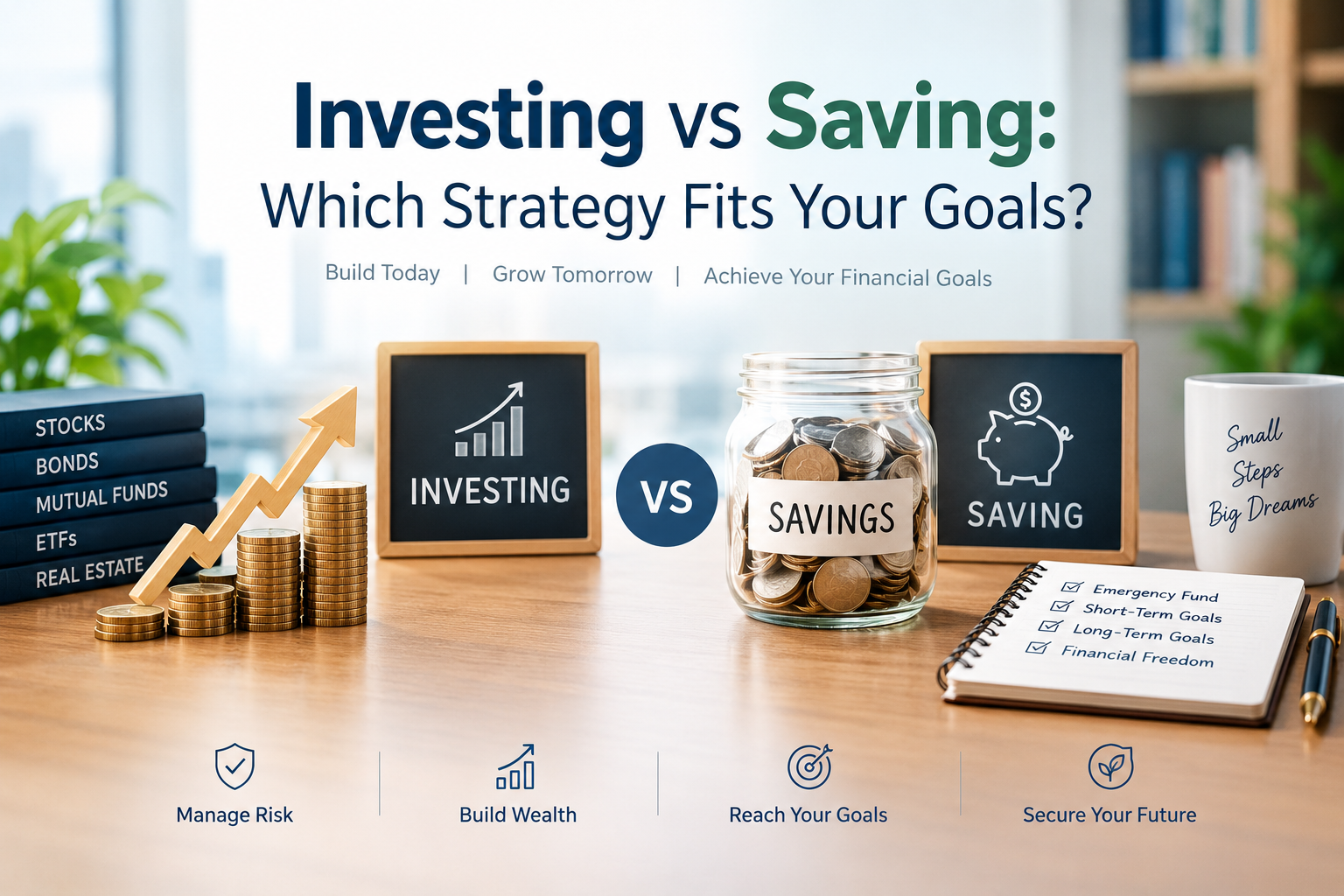
Choosing between investing vs saving is an important step toward building a stronger financial future. Both approaches help you set money aside for future needs. However, they serve different purposes and involve different levels of risk.
Investing vs Saving is not simply a choice between keeping money in a bank account and buying stocks. It is about understanding when you need your money, how much risk you can accept and what you want to achieve. Saving can help protect money for emergencies and short-term expenses. Investing vs saving can offer greater growth potential for long-term goals, although losses are possible. The right approach depends on your personal circumstances.
Someone preparing for a home deposit next year may need easy access to cash. Someone planning for retirement several decades away may have more time to handle market fluctuations. Many people benefit from using both strategies rather than choosing only one. In this guide, you will learn how saving and investing work, compare their benefits and risks, explore practical examples and discover how to choose an approach that fits your financial goals.

What Is the Difference Between Investing and Saving?
Saving means setting aside money for future use, usually in a savings account or another relatively low-risk and accessible place. The main purpose is to preserve money and make it available when needed. Depending on the account and country, you may also earn interest on your balance.
Investing means using money to purchase assets such as stocks, bonds, mutual funds or exchange-traded funds (ETFs). These assets may increase in value or generate income through interest or dividends. However, their prices can also fall and you may lose some or all of the money invested. Understanding Investing vs Saving starts with recognizing these different purposes. Saving generally emphasizes accessibility and stability. Investing focuses more on potential growth over time while accepting greater uncertainty.
For example, money needed for next month’s rent belongs in an accessible account rather than a stock market investment. Money intended for retirement many years from now may be suitable for a diversified investment portfolio, depending on your circumstances and tolerance for risk. The important point is that neither approach is automatically better. Each has a role in a balanced financial plan.
How Does Saving Money Work?
Saving usually begins when you set aside part of your income instead of spending it. You can transfer a fixed amount into a separate account after receiving your salary or save whenever extra money becomes available.
A savings account can help you organize your money for specific purposes. These might include emergency expenses, education costs, a holiday or an upcoming home purchase.
Benefits of Saving
One major benefit is accessibility. You can generally withdraw money from an ordinary savings account more easily than you can access funds held in some investments. Certain accounts have withdrawal restrictions or fees, so you should check the terms before opening one.
Saving also provides financial stability. An emergency reserve can help cover unexpected medical bills, urgent home repairs or a temporary loss of income without relying entirely on credit cards or loans. The Consumer Financial Protection Bureau recommends establishing dedicated emergency savings and building the habit of making regular contributions. Consumer Financial Protection Bureau+1
Another advantage is predictability. Depending on the account type, its interest rate and applicable deposit protection, your balance may be more stable than the market value of investments.
Limitations of Saving
Saving has limitations too. Interest earned on cash may not keep pace with inflation. When prices rise faster than your savings balance, the amount you can purchase with that money decreases. For example, if your savings earn 2% interest over a year while prices rise by 4%, your purchasing power declines by approximately 1.9%, before taxes and fees. This is an illustrative example rather than a prediction of future rates.
This is one reason why Investing vs Saving matters when planning for distant financial goals. Cash can protect short-term spending needs, but relying entirely on cash for decades may make it harder to grow your wealth in real terms.
How Does Investing Work?
Investing involves putting money into assets with the expectation that they may generate returns over time. Common investments include shares in companies, government and corporate bonds, mutual funds and ETFs. Unlike a typical savings account, an investment does not usually promise a stable balance or a guaranteed return. Its value can rise or fall depending on market conditions, economic developments, interest rates and the performance of the underlying assets.
Common Types of Investments
- Stocks: Represent ownership in a company. Investors may benefit from price increases and dividends when companies pay them.
- Bonds: Represent loans to governments or companies. They may provide interest income but carry risks such as default and changing market prices.
- Mutual funds: Pool money from multiple investors to purchase a collection of assets according to the fund’s objectives.
- ETFs: Trade on exchanges like stocks and can provide exposure to a collection of investments through one fund.
Each investment has different costs, risks and potential returns. Before choosing an option, consider its fees, diversification, liquidity and suitability for your goals. The US Securities and Exchange Commission’s Investor.gov provides guidance on investment products and risk. Investor+1
Benefits of Investing
The main attraction of investing is its potential to grow money over longer periods. Some investments also generate income through dividends or interest. Reinvesting those earnings may support compounding, in which returns can generate additional returns over time.
Regular contributions can also help you develop a disciplined financial routine. Instead of trying to predict every market movement, you can invest amounts you can afford at regular intervals according to a suitable plan. However, Investing vs Saving requires an honest assessment of risk. Investment growth is not guaranteed, and even a diversified portfolio can lose value during a market downturn.
Risks of Investing
Market volatility is one of the most visible risks. An investment portfolio worth $5,000 could decline to $4,000 during a downturn. If you need to withdraw money at that moment, you may have to accept a loss. Other risks include high fees, poor diversification, fraud and investing vs saving in products you do not understand. Diversification can reduce exposure to individual investments but it cannot eliminate all losses. Investor+1
This is why Investing vs Saving should be considered alongside your financial security. Investing money that you need for essential expenses can leave you vulnerable if markets fall at the wrong time.
Investing vs Saving: Key Differences
The following table highlights the main differences between the two approaches.
| Feature | Saving | Investing |
|---|---|---|
| Main purpose | Preserve money and provide access | Seek long-term growth or income |
| Typical options | Savings accounts and eligible deposits | Stocks, bonds, mutual funds and ETFs |
| Risk level | Usually lower with protected eligible deposits | Varies by investment and market conditions |
| Potential return | Usually more predictable but often modest | Potentially higher but uncertain |
| Access to money | Often easy, depending on account terms | Depends on the asset and market conditions |
| Effect of inflation | Purchasing power may decline | Returns may outpace inflation but are not guaranteed |
| Best suited for | Emergencies and many short-term goals | Suitable medium- and long-term goals |
| Main concern | Low returns and loss of purchasing power | Market losses and investment costs |
Deposit protection rules differ between countries and institutions. Investment products generally do not receive the same protection against market losses. Always verify local regulations and the terms of your financial accounts. The practical lesson from Investing vs Saving is that you should match the financial tool to the purpose of the money rather than treating every dollar the same way.

Which Strategy Is Better for Your Financial Goals?
Your goal and the time available to achieve it are two of the most important factors when choosing between these approaches.
Saving for Short-Term Goals
Saving is often appropriate when you expect to use money within the next few years. Examples include paying rent, buying essential appliances, preparing for a holiday or saving a home deposit that you will need soon. Imagine that you want to save $3,000 for a course you plan to attend in eight months. Keeping the money in a suitable savings account can help protect the amount you need from stock market fluctuations.
With Investing vs Saving, the main question for short-term goals is whether you can afford to lose value just before the money is needed. If the answer is no, accessible and relatively stable savings may be more suitable than volatile investments.
Building an Emergency Fund
An emergency fund is money reserved for unexpected costs. It may cover medical expenses, urgent repairs, job loss or other essential needs. A common planning target is three to six months of essential living expenses. However, the right amount depends on your income stability, family responsibilities, insurance coverage and access to other financial resources.
For example, someone with essential monthly expenses of $2,000 might aim to build a reserve of $6,000 to $12,000. This is a planning example rather than a universal requirement. An emergency fund should normally be held somewhere safe and accessible. Investing the entire reserve in stocks or other volatile assets could force you to sell at a loss when an emergency occurs.
In Investing vs Saving, emergency money usually deserves priority because it protects your ability to manage unexpected financial shocks. You can begin with a smaller target if a full reserve feels difficult to achieve.
Planning for Long-Term Wealth
Long-term goals may include retirement, future education expenses or financial independence. When you have many years before needing the money, investing may offer an opportunity for growth that ordinary cash savings may not provide. For example, an individual who plans to retire in 25 years may consider a diversified portfolio that reflects their time horizon and ability to tolerate losses. The appropriate mix of stocks, bonds and cash depends on their circumstances.
Compounding can help investments grow when returns are earned and reinvested. However, the outcome depends on investment performance, contribution amounts, fees, taxes and the length of time invested. A sensible approach to Investing vs Saving is to protect near-term needs first and then consider investing money intended for longer-term objectives.
Preparing to Buy a Home
A home deposit is a useful example of how both strategies can work together. Suppose you plan to purchase a home in two years. You may prefer to keep the money needed for the deposit in an appropriate savings account rather than exposing it to substantial stock market fluctuations.
If you are planning to purchase a property much later, you might evaluate whether some of your longer-term funds are suitable for investing. Your decision should account for the possibility that investments could fall in value before the purchase date. The Investing vs Saving decision for a home deposit should reflect the purchase timeline, the amount required and your ability to delay the purchase if markets decline.
Investing vs Saving: A Practical Example
Consider Maya, who has $10,000 available after covering her regular expenses. She wants to prepare for unexpected costs while also building wealth for retirement.
Instead of putting all her money into one place, Maya divides her financial priorities.
| Financial goal | Amount | Approach |
|---|---|---|
| Emergency reserve | $5,000 | Accessible savings |
| Upcoming expenses | $2,000 | Savings account |
| Long-term retirement goal | $3,000 | Diversified investments |
These figures are illustrative. Maya would need to check whether her emergency reserve is sufficient and whether investing the remaining amount suits her financial circumstances. The savings portion helps her handle near-term needs without relying on selling investments. The investment portion gives her an opportunity to participate in long-term market growth, while accepting the possibility of losses.
This example shows why Investing vs Saving does not need to be an either-or decision. A combination can help balance liquidity, stability and growth potential. Now imagine another person who has high-interest credit card debt and no emergency reserve. That person may benefit more from addressing expensive debt and establishing some savings before committing substantial money to investments. The right sequence depends on interest rates, essential expenses and available resources.
How to Choose Between Investing and Saving
Before deciding where your money should go, review your current financial position. A clear plan can help you make better decisions without taking unnecessary risks.
Step 1: Identify Your Financial Goals
Write down what you want to achieve and when you will need the money. Separate goals such as an emergency reserve, a home deposit and retirement savings. This makes Investing vs Saving easier to evaluate because each goal has its own timeline and financial requirements.
Step 2: Review Your Income and Expenses
Calculate how much money remains after paying for housing, food, transport, insurance and other essential expenses. This helps you determine how much you can regularly set aside without creating financial pressure. You do not need a large income to begin developing better money habits. Start with an affordable amount and adjust it when your circumstances change.
Step 3: Build a Financial Safety Net
Consider establishing an emergency fund before investing heavily. If you have expensive debt, compare the cost of that debt with your other priorities. For many households, Investing vs Saving starts with financial stability rather than investment selection. A cash reserve can reduce the need to borrow money when unexpected expenses arise.
Step 4: Understand Your Risk Tolerance
Risk tolerance describes your willingness and ability to accept investment losses. Someone who depends on their money for upcoming expenses may have less capacity to accept risk than someone investing for retirement several decades away.
Do not assume that a long time horizon makes every investment suitable. Your income, debts, responsibilities and emotional response to market declines also matter. A thoughtful Investing vs Saving plan should reflect the amount of risk you can realistically manage rather than the returns you hope to earn.
Step 5: Compare Costs and Account Rules
Savings accounts may have minimum balance requirements, withdrawal restrictions or fees. Investments may involve brokerage charges, fund management fees, taxes and other costs.
Review these details before opening an account or purchasing an investment. Check the applicable deposit protection arrangements in your country and remember that market investments can lose value. Comparing these details helps you make a more informed Investing vs Saving decision and avoid unnecessary costs.
Step 6: Review Your Plan Regularly
Your financial priorities may change after a new job, a move, a major purchase or a change in family responsibilities. Review your goals and savings progress periodically.
As your emergency fund grows, you may be able to direct more money toward longer-term investments. If your expenses increase, you might temporarily prioritize cash reserves instead. A flexible Investing vs Saving strategy can adapt to your changing circumstances without abandoning your long-term goals.
Common Mistakes to Avoid
People sometimes focus on returns without considering what their money needs to do. Avoiding a few common mistakes can help you make more balanced financial decisions. Investing without emergency savings: Unexpected bills can force you to sell investments at an unfavorable time. Build a suitable cash reserve according to your circumstances.
Keeping all long-term money in cash: Cash offers stability and access, but inflation can reduce purchasing power. Consider if your long-term goals require a different approach. Expecting guaranteed investment profits: No ordinary market investment can guarantee high returns without risk. Be cautious of anyone promising easy wealth or unusually high guaranteed profits.
Ignoring fees and taxes: Even small recurring costs can affect long-term results. Understand the charges and tax rules that apply to your accounts and investments. Choosing based on emotions: Fear can encourage investors to sell during a downturn, while excitement can lead to rushed purchases. A clear plan can help you stay focused on your objectives. Ultimately, Investing vs Saving works best when your decisions are based on your goals, time horizon and financial capacity rather than short-term market excitement.

Frequently Asked Questions
Q1. Is investing better than saving?
Neither is always better. Saving is generally more suitable for emergencies and many short-term goals, while investing may be appropriate for long-term goals when you can accept market risk. The best choice depends on your financial needs and timeline.
Q2. How much money should I save before investing?
There is no universal amount. Many people aim for three to six months of essential expenses in emergency savings, although the right target varies. Your debt, income stability and financial responsibilities should also influence the decision.
Q3. Can I save and invest at the same time?
Yes. You can keep money for emergencies and upcoming expenses in suitable savings accounts while investing a separate amount for longer-term goals. This approach helps you balance accessibility with potential growth.
Q4. Is investing risky for beginners?
Investing carries risks for beginners and experienced investors alike. You can reduce some risks by learning about investment products, diversifying appropriately, understanding fees and avoiding investments you do not understand. However, diversification cannot eliminate market losses.
Q5. How does inflation affect saving and investing?
Inflation reduces the purchasing power of money when prices rise. If your savings earn less than the inflation rate after relevant costs and taxes, their purchasing power may decline. Investments may outpace inflation over time, but their returns are uncertain and losses are possible.
Conclusion
Your financial future does not depend on choosing one strategy and ignoring the other. Saving helps you prepare for emergencies, protect money for upcoming expenses and maintain access to cash. Investing gives you an opportunity to pursue long-term growth while accepting the possibility of losses.
The most useful approach to Investing vs Saving begins with understanding your financial priorities. Set clear goals, review your income and expenses, build a suitable emergency reserve and consider expensive debt before investing substantial amounts. Once your immediate needs are covered, evaluate whether investing can support your longer-term plans. Choose investments that match your time horizon and risk tolerance. Review your progress regularly and make adjustments when your circumstances change.
There is no single formula that works for everyone. By combining sensible saving habits with informed investment decisions, you can build a financial plan that supports both your present needs and your future ambitions. At WealthCoveNest.com, our goal is to make financial concepts easier to understand so you can make informed decisions about your money.