Introduction
Understanding how risk, return and time work together is one of the most important steps toward becoming a confident investor. If you are starting with a small amount of money or planning for long-term financial goals, learning the Investing Basics can help you make informed decisions.
Investing is not simply about choosing stocks or finding opportunities that promise high returns. It involves understanding uncertainty, setting realistic expectations and deciding how much risk you can afford to take. Time also plays an important role because different investments behave differently over short and long periods.
This guide explains the Investing Basics in simple language. You will learn what investment risk means, how returns work, why time matters and how these three factors influence investment decisions. You will also explore practical examples that can help you understand the relationship between potential gains and possible losses. By the end, you should have a clearer framework for evaluating investments and building a strategy that fits your financial goals.

What Are the Investing Basics?
The Investing Basics are the fundamental principles that explain how investments work and what investors should consider before committing their money. These principles include risk, return, time horizon, diversification, costs and personal financial goals. Investing means putting money into assets with the expectation that they may grow in value or generate income. Common investments include stocks, bonds, mutual funds, exchange-traded funds and real estate. Each option has different characteristics and risks.
For example, a stock may increase in value when a company performs well. A bond may provide interest payments according to its terms. A rental property may generate rental income while also changing in market value. However, none of these outcomes is guaranteed in every situation. Stock prices can fall, bond issuers can default and rental properties can remain vacant.
Learning the Investing Basics helps you evaluate these possibilities before making decisions. It also encourages you to look beyond advertised returns and consider what could happen if an investment performs worse than expected.
A sensible investment strategy begins with three questions:
- What return am I hoping to achieve?
- How much loss could I reasonably tolerate?
- When will I need the money?
Your answers can help determine which investments deserve further research.
Understanding Investment Risk
Risk is the possibility that an investment will lose value or deliver a result different from what you expected. It is an essential part of the Investing Basics because every investment carries some uncertainty.
The amount of risk varies depending on the asset you choose. A government bond issued by a financially strong government may have relatively low default risk in its own currency. However, its market value can still fall when interest rates rise. A single company’s stock may offer greater growth potential but can also experience sharp losses.
Common Types of Investment Risk
Understanding the Investing Basics means recognizing the different ways your money can be affected.
- Market risk: The value of investments can fall because of economic changes or investor sentiment.
- Inflation risk: Your money may lose purchasing power when prices rise faster than your investment returns.
- Interest rate risk: Bond prices generally fall when market interest rates rise.
- Credit risk: A borrower may fail to make interest payments or repay the original amount owed.
- Liquidity risk: You may struggle to sell an investment quickly at a fair price.
- Concentration risk: Holding too much money in one company or asset type can increase your exposure to a single setback.
These risks do not affect every investment equally. A diversified stock fund faces different challenges from a fixed-rate bond or a rental property. The Investing Basics also involve understanding your personal risk tolerance. Some people can accept significant fluctuations because they have stable income and long-term goals. Others may find even modest losses difficult to manage.
Your financial circumstances matter as much as your feelings about risk. If you need your investment money soon to pay tuition or purchase a home, a major market decline could create a serious problem.
Does Higher Risk Always Mean Higher Returns?
Investors generally expect compensation for taking on additional risk. However, this does not mean every risky investment will generate higher profits. A company can perform poorly despite operating in a promising industry. A speculative asset can lose most of its value. Even experienced investors can make decisions that result in losses.
The Investing Basics teach an important distinction between expected return and actual return. Expected return is an estimate based on assumptions. Actual return is what you earn or lose after the investment period ends. Before investing, consider the potential upside alongside the possible downside. Ask yourself whether the investment still makes sense if its value falls substantially.
What Is Investment Return?
Investment return measures how much an investment gains or loses over a particular period. It can include changes in market value and income received from the asset. For example, imagine purchasing shares for $1,000. One year later, those shares are worth $1,080, and you received $20 in dividends.
Your total gain is $100 before fees and taxes. Your total return is 10% because the gain equals 10% of your original $1,000 investment. The Investing Basics become easier to understand when you separate investment income from changes in market price.
Types of Investment Returns
Capital gains: These occur when an asset is sold for more than its purchase price. If you buy a share for $40 and sell it for $50, your capital gain is $10 per share before costs and taxes. Dividends: Some companies distribute part of their profits to shareholders. Dividends can provide income but companies may reduce or suspend payments. Interest income: Certain bonds and savings products pay interest according to their terms. The amount and timing depend on the product and issuer.
Rental income: Property owners may receive rent from tenants. However, maintenance, insurance, taxes, vacancy periods and other expenses reduce the amount retained. The Investing Basics require you to look at total return rather than focusing on only one source of income. A stock with a large dividend may still produce a negative overall return if its price falls substantially.
Nominal Return vs Real Return
A nominal return is the percentage gain or loss before adjusting for inflation. A real return reflects the change in purchasing power after inflation. Suppose your investment earns 6% over one year while inflation is 3%. Your approximate real return is 3% before taxes and fees.
The more precise calculation is:
\[ \text{Real Return}=\frac{1+\text{Nominal Return}}{1+\text{Inflation Rate}}-1 \]
Using the example above, the real return is approximately 2.91%.
This distinction matters because an account balance can increase while your money’s purchasing power grows much more slowly. The Investing Basics are especially useful here because they encourage you to evaluate whether an investment supports your actual financial goals rather than simply producing a positive number.
Why Time Matters When Investing
Time is one of the most important factors in a long-term investment strategy. Your time horizon is the period between investing your money and expecting to use it.
Someone saving for a home deposit in two years has different needs from someone investing basics for retirement in 30 years. The first person has less time to recover from a market decline before needing the money. The Investing Basics help you connect each financial goal with an appropriate time horizon.
Short-Term Investing
Short-term goals usually involve money you expect to need within the next few years. Examples include education costs, an upcoming house purchase or a planned business expense. For these goals, preserving the money and maintaining access to it may be more important than pursuing substantial growth.
Depending on your country, suitable options might include insured savings accounts, short-term deposits or other relatively low-volatility instruments. Check withdrawal restrictions, deposit protection limits, currency exposure and the financial strength of the provider. Low-risk does not mean risk-free. Inflation may reduce purchasing power and some products may impose penalties for early withdrawals.
Long-Term Investing
Long-term investing gives your money more time to grow and allows you to continue contributing through different market conditions. Stocks and diversified stock funds may suit some long-term goals because they offer growth potential. However, they can experience significant losses, sometimes over extended periods.
The Investing Basics do not suggest that holding investments for many years guarantees profits. Instead, a longer time horizon may give you more flexibility to withstand temporary declines without being forced to sell. Your ability to wait matters. If a downturn would cause you to abandon your plan or sell investments to meet essential expenses, your portfolio may be too risky for your circumstances.
How Compounding Can Support Growth
Compounding occurs when investment earnings remain invested and generate additional earnings over time. Consider an illustrative investment of $1,000 that earns an average annual return of 5%. If all earnings remain invested, the account could grow to approximately $1,629 after ten years. Illustrative calculation assumes a constant 5% annual return with annual compounding. It excludes taxes, fees and inflation. Actual returns fluctuate and may be negative.
The formula is:
\[ FV=P(1+r)^n \]
Where:
- \(FV\) is the future value.
- \(P\) is the initial investment.
- \(r\) is the annual return expressed as a decimal.
- \(n\) is the number of years.
The Investing Basics show why starting early can be useful. More time gives compounding more opportunities to work, although the final outcome still depends on contributions, returns, costs and market conditions. Regular contributions can also help build an investment portfolio. Nevertheless, investing basics regularly does not eliminate the risk of losses and returns are never guaranteed.

How Risk, Return and Time Work Together
Risk, return and time are connected. You cannot evaluate one properly without considering the other two. A portfolio designed for growth may be appropriate for a person with a long time horizon and the financial capacity to tolerate losses. The same portfolio may be unsuitable for someone who needs the money next year. The Investing Basics encourage you to make decisions based on your own circumstances instead of copying another investor’s strategy.
Consider these three hypothetical investors:
| Investor | Financial goal | Main consideration |
|---|---|---|
| Alex | Buy a home in two years | Protecting the deposit |
| Sam | Build wealth over 15 years | Balancing growth and risk |
| Jordan | Save for retirement in 30 years | Long-term growth and diversification |
Alex may prioritize stability and access to money. Sam may choose a balanced portfolio that combines growth-oriented and lower-volatility assets. Jordan may have more time to tolerate market fluctuations, depending on personal circumstances. These are illustrations rather than universal recommendations. The right allocation depends on each person’s financial position, obligations and goals. The Investing Basics also help explain why an investment that works well for one person may not work well for someone else.
How to Manage Investment Risk
You cannot remove every investment risk, but you can take practical steps to manage your exposure.
Diversify Your Portfolio
Diversification means spreading your money across investments rather than depending on one asset or company. For example, an investor who holds shares in one business is heavily exposed to that company’s performance. A diversified fund may spread exposure across many companies and sectors.
However, diversification cannot guarantee profits or prevent losses during broad market declines. You should also check whether different funds hold many of the same investments. The Investing Basics include diversification because it can reduce the impact of poor performance from an individual holding.
Choose an Appropriate Asset Allocation
Asset allocation means deciding how much money to place in different asset classes, such as stocks, bonds and cash. A portfolio with more stocks may offer greater long-term growth potential but can experience larger declines. A portfolio with more cash and lower-volatility assets may be more stable but could struggle to outpace inflation.
The appropriate mix depends on your goals, time horizon and ability to withstand losses. Review your allocation when your circumstances change.
Understand Fees and Taxes
Investment costs reduce the money available to earn future returns. Common costs include fund expense ratios, brokerage charges, advisory fees and transaction expenses.
Taxes may also affect your final return. The rules depend on where you live, the type of account you use and the income your investment generates. The Investing Basics encourage you to compare the total cost of an investment rather than looking only at its advertised performance.
Keep Emergency Savings Separate
An emergency fund can help cover unexpected expenses without forcing you to sell investments during a downturn. The appropriate amount depends on your household expenses, income stability, dependants and access to other resources.
Separating emergency savings from long-term investments can make it easier to follow your investment plan when unexpected bills arise.
Review Your Investments Periodically
Check whether your investments still match your goals and risk tolerance. You do not need to react to every market headline. Rebalancing may be appropriate when market movements change your portfolio’s original allocation. This involves adjusting holdings to bring the portfolio closer to your chosen mix.
The Investing Basics are about maintaining a thoughtful strategy rather than trying to predict every market movement.
Common Investing Mistakes to Avoid
New investors can improve their decisions by recognizing common mistakes before committing money.
Chasing quick profits: Investments promoted as guaranteed or unusually profitable deserve careful scrutiny. High promised returns with little or no risk are a major warning sign.
Ignoring diversification: Putting most of your money into one company or sector can expose you to avoidable concentration risk.
Following market emotions: Fear can encourage selling after a decline, while excitement can encourage buying after prices have already risen. A written plan can help you make more consistent decisions.
Forgetting inflation and fees: A positive nominal return may not translate into meaningful growth in purchasing power after expenses and inflation.
Investing money you need soon: Assets that fluctuate significantly may be unsuitable for money needed for an upcoming essential expense.
Expecting guaranteed outcomes: Historical performance and financial forecasts cannot tell you exactly what an investment will return in the future.
These lessons are central to the Investing Basics because sound decisions require realistic expectations, patience and a clear understanding of possible losses.
A Practical Plan for Beginner Investors
You can put these principles into practice with a simple process.
- Set a clear goal. Decide what you are investing basics for and when you expect to use the money.
- Review your finances. Understand your income, expenses, debts and emergency savings before choosing investments.
- Assess your risk capacity. Consider how much loss you could financially withstand without disrupting essential plans.
- Learn about available investments. Research their risks, expected income, fees, liquidity and tax treatment.
- Choose a suitable allocation. Match the balance of assets to your goals and time horizon.
- Invest consistently if appropriate. Regular contributions can support long-term planning but do not guarantee positive returns.
- Review your plan. Reassess your investments when your goals or circumstances change.
The Investing Basics provide a framework for following these steps without relying on market predictions or unrealistic promises. For further reading, the US Securities and Exchange Commission’s Investor.gov introduction to investing explains investment risk, compound growth and diversification. Investors outside the United States should also check their own country’s financial regulator for applicable rules and protections.

Frequently Asked Questions
Q1. What are the Investing Basics every beginner should learn?
The Investing Basics include understanding risk, return, time horizon, diversification, fees and financial goals. These principles help beginners compare investments and make informed decisions.
Q2. Can investing generate guaranteed returns?
No. Most investments carry some risk of loss and actual returns can differ from expectations. Be cautious of anyone promising high returns without risk.
Q3. How much money do I need to start investing?
The amount depends on the investment platform and product you choose. Some funds and platforms allow small initial contributions but minimum requirements and fees vary by country.
Q4. Is long-term investing less risky than short-term investing?
A longer time horizon can give you more opportunity to recover from market declines. However, it does not eliminate the possibility of losses or guarantee a positive return.
Q5. How can I balance investment risk and return?
Start by defining your goals and assessing your financial situation. Diversify your investments, compare costs and choose a portfolio that matches your time horizon and ability to tolerate losses.
Final Thoughts
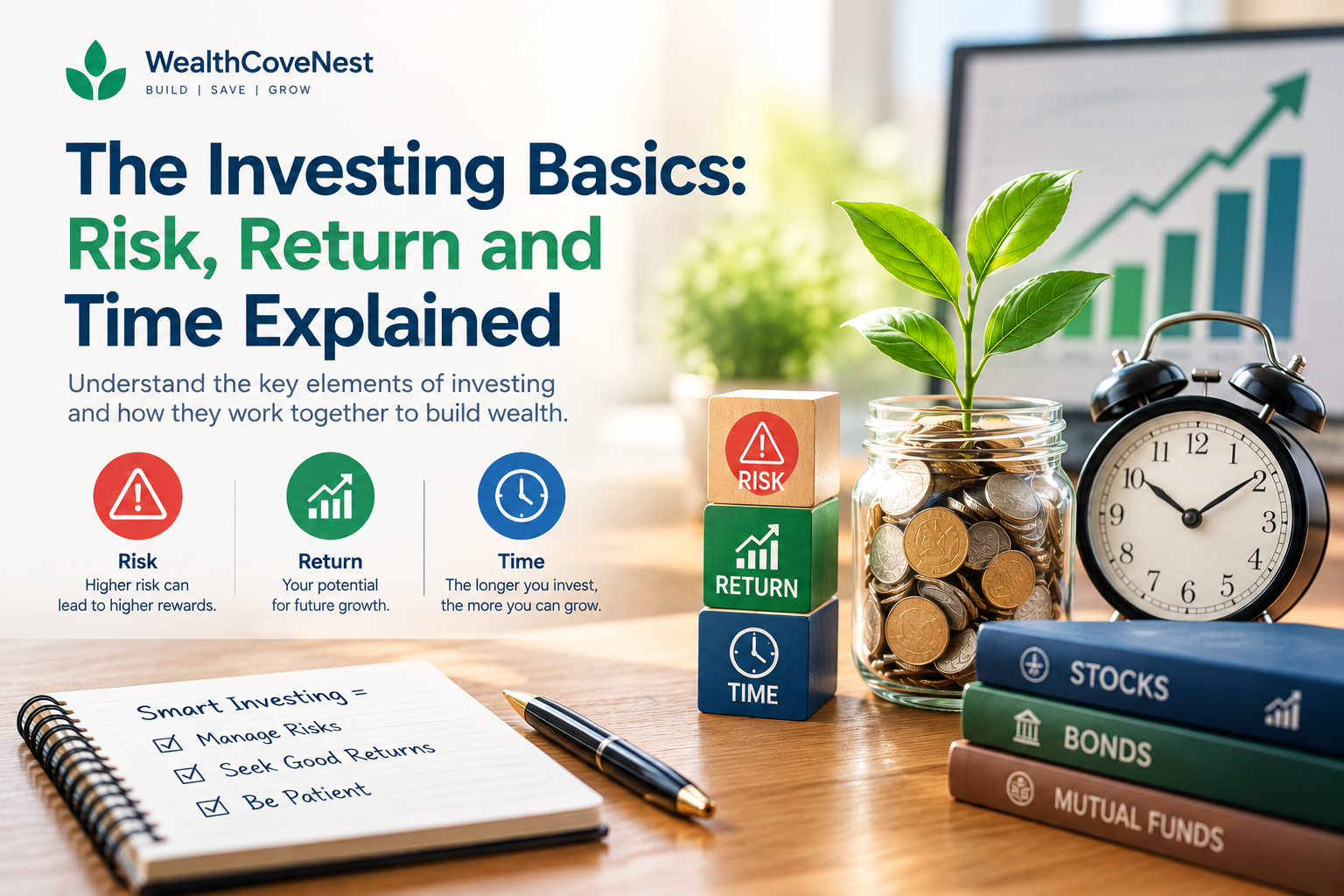
Learning the Investing Basics is about making informed decisions rather than chasing the highest possible return. Risk helps you understand what could go wrong. Return helps you evaluate potential rewards. Time influences how much flexibility you have to pursue your financial goals.
These three factors work together. A suitable investment strategy should reflect your personal circumstances rather than following market trends or another person’s portfolio. Start by setting realistic goals and building a strong financial foundation. Learn about different investments before committing your money. Review costs and risks carefully and remember that no strategy can guarantee profits.
The Investing Basics can provide a useful foundation for making thoughtful financial decisions over time. With patience, continued learning and a realistic plan, you can work toward your goals while understanding the uncertainty involved.
2 thoughts on “The Investing Basics: Risk, Return and Time Explained”