Introduction
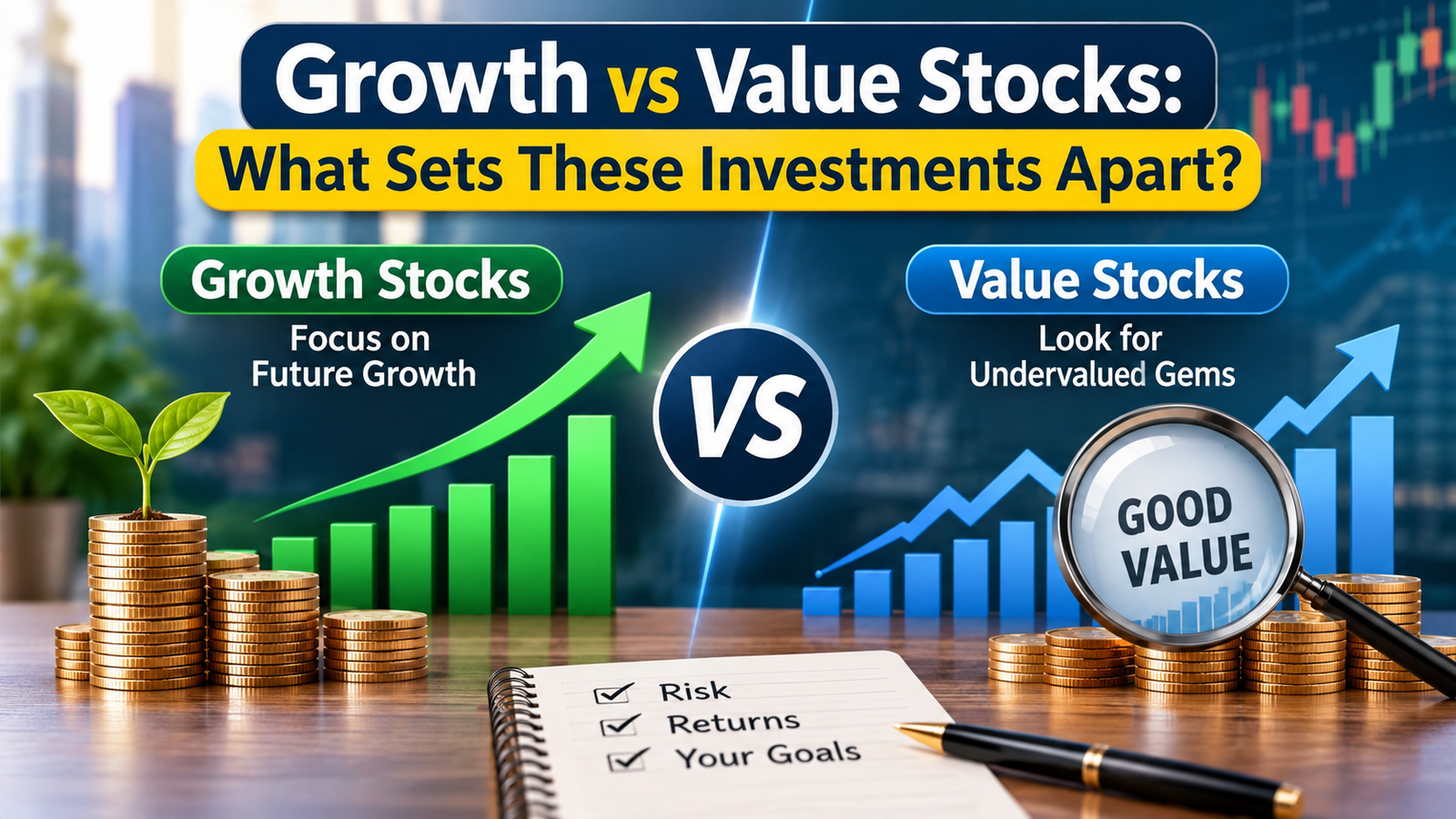
Choosing between different types of stocks can feel confusing for new and experienced investors alike. Two of the most widely discussed investing styles are growth investing and value investing. Both approaches involve buying shares in companies but they focus on different characteristics and expectations.
Value Stocks are generally shares that investors believe are trading below what the underlying business may be worth based on factors such as earnings assets cash flow or other financial measures. Growth stocks are usually associated with companies expected to increase their revenue or earnings faster than the broader market. The difference may sound simple. However deciding whether Value Stocks or growth stocks fit your investment strategy requires a closer look at risk valuation dividends business performance and your investing time horizon.
Neither approach guarantees success. A growth company can fail to meet high expectations and a stock that looks cheap can remain cheap for years. Understanding how these investment styles work can help you make more informed decisions and build a portfolio that better matches your financial goals.
Important: This article is for educational purposes and is not personal investment advice. All investing involves risk including the possible loss of principal.

What Are Value Stocks?
Value Stocks are shares that appear inexpensive compared with certain measures of a company’s financial performance or underlying fundamentals. Investors who focus on Value Stocks generally look for situations where they believe the market price does not fully reflect the company’s potential value. Financial measures may include the price-to-earnings ratio price-to-book ratio cash flow and other indicators.
A company may become a value opportunity for many reasons. Investors may worry about slower business growth a temporary problem within the company a weak economic environment or challenges affecting an entire industry. The important question is whether the market has correctly identified a serious long-term problem or has become overly pessimistic.
Investor.gov notes that value stocks may have relatively low price-to-earnings ratios and may have fallen out of favor with investors. People who buy them may believe the market has overreacted and that the share price could eventually recover.
Common Characteristics of Value Stocks
Although every company is different Value Stocks often have several characteristics:
- Lower valuation ratios compared with some other companies
- More established business operations
- Stable earnings or cash flow
- Stronger emphasis on current fundamentals
- Potential dividend payments
- Slower expected growth than high-growth companies
These characteristics are not guaranteed. A stock cannot be judged solely by one financial ratio. Investors usually need to consider the company’s business model financial health competitive position and future prospects.
What Are Growth Stocks?
Growth stocks are shares in companies expected to grow revenue earnings or other important business measures faster than the market average. These companies may operate in rapidly expanding industries or have products and services that investors expect to become more valuable over time. Growth businesses often reinvest a significant portion of their earnings into expansion research product development or new markets.
Growth stocks frequently trade at higher valuations because investors are willing to pay more today based on expectations about future growth. According to recent educational material from major investment firms growth companies often have faster expected earnings growth and may place less emphasis on paying dividends.
Common Characteristics of Growth Stocks
Growth stocks may have:
- Rapid revenue or earnings growth
- Higher valuation ratios
- Strong expectations for future expansion
- Greater investment in research and development
- Lower dividend payments or no dividends
- Higher sensitivity to changing investor expectations
The key word is expectation. A company’s future growth is never guaranteed. When investors pay a high price based on strong expectations even a small disappointment can sometimes cause a significant decline in the stock price.
Growth Stocks vs Value Stocks: The Main Differences
The easiest way to understand the difference is to compare what each investment style emphasizes.
| Factor | Growth Stocks | Value Stocks |
|---|---|---|
| Main focus | Future business growth | Current valuation and fundamentals |
| Typical valuation | Often higher | Often lower relative to fundamentals |
| Dividend focus | Usually lower | May be more common |
| Business stage | Can be rapidly expanding | Often more mature or established |
| Main opportunity | Strong future growth | Potential market undervaluation |
| Key risk | Growth expectations may fail | A cheap stock may stay cheap |
This comparison is useful but it should not be treated as a strict rule. A company can have characteristics associated with both styles and classifications can change over time.
How Investors Identify Value Stocks
Finding Value Stocks usually involves fundamental analysis. Investors study the business rather than simply looking at whether the share price has fallen.
Price-to-Earnings Ratio
The price-to-earnings ratio compares a company’s share price with its earnings. A lower P/E ratio may suggest that a stock is less expensive relative to its earnings than another company. However a low P/E ratio does not automatically mean a company is a good investment.
A company may have a low valuation because investors expect profits to decline. This is why Value Stocks should be evaluated in a broader business context.
Price-to-Book Ratio
The price-to-book ratio compares a company’s market value with its book value.
This measure can sometimes be useful when comparing businesses with significant tangible assets. However it may be less helpful for companies whose value comes mainly from intangible assets intellectual property or brand strength.
Cash Flow and Financial Strength
Investors may also examine operating cash flow debt levels profit margins and balance sheet strength.
Strong fundamentals can support the argument that Value Stocks are genuinely undervalued. Weak financial conditions may suggest that a seemingly cheap st ock carries significant risks.
Comparing Companies With Their Peers
Comparisons are often more useful when companies operate in similar industries.
For example a lower valuation in one sector may be normal while the same valuation in another sector could be unusual. Investors should avoid comparing ratios without understanding the differences between industries and business models.
Why Can Value Stocks Become Undervalued?
Value Stocks can become inexpensive for several reasons. A company may face temporary challenges such as weaker sales management changes or negative publicity. An entire sector may also become unpopular during changing economic conditions. Sometimes investors simply prefer companies with faster expected growth and pay less attention to slower-growing businesses. This can create opportunities if the market’s negative view becomes too extreme.
However investors should remember an important risk known as a value trap. A value trap occurs when a stock appears cheap but remains inexpensive because the underlying business has serious problems. Fidelity and other investment education sources highlight that a stock can look undervalued while facing risks that prevent its price from recovering. This is why careful research matters when evaluating Value Stocks.
The Potential Benefits of Value Stocks
Potential for Price Recovery
The main attraction of Value Stocks is the possibility that the market eventually recognizes stronger business fundamentals.
If the investor’s assessment is correct the stock price may rise as concerns improve or the company demonstrates stronger performance.
Possible Dividend Income
Many mature companies return part of their profits to shareholders through dividends. Not every value company pays dividends but dividend payments are generally more common among established businesses than among companies focused heavily on expansion.
Focus on Fundamentals
Investing in Value Stocks encourages investors to examine earnings cash flow assets and financial strength. This approach can help investors look beyond market excitement and focus on the underlying business.
Portfolio Diversification
Value and growth investments can perform differently during different market conditions. Holding exposure to both styles may help investors avoid relying entirely on one part of the stock market.
Vanguard notes that broad diversification can help reduce volatility and that growth and value stocks can both play a role in a diversified equity portfolio. Diversification does not guarantee a profit or prevent losses in a declining market.
The Risks of Value Stocks
The Value Trap Risk
The biggest risk is assuming that every cheap company is a bargain. Some Value Stocks trade at low valuations because their businesses face declining demand weak finances or serious competitive problems.
Slow Recovery
Even a genuinely undervalued company may take a long time to recover. The market may continue to ignore positive developments for months or years. Investors need patience and should avoid assuming that every undervalued stock will quickly rise.
Business and Industry Changes
Established companies can still face major disruption. Technology changing consumer preferences economic conditions and new competitors can affect businesses that once appeared stable.
Dividends Are Not Guaranteed
A company can reduce or eliminate its dividend if financial conditions worsen. Investors should never treat past dividend payments as a guarantee of future income.

The Potential Benefits of Growth Stocks
Growth stocks can offer strong long-term potential when companies successfully increase revenue and earnings. A successful growth business may expand into new markets develop valuable products and improve profitability over time.
Growth stocks may also benefit from major long-term trends such as technological innovation changing consumer behavior or new industries. However these potential benefits usually come with higher expectations. Investors may pay a premium for future growth and that premium can create additional risk.
The Risks of Growth Stocks
Growth stocks can experience significant price volatility. When interest rates rise or investors become less willing to take risks higher-valued companies may face stronger selling pressure. A business can also experience a sharp decline if its earnings growth fails to meet expectations.
The company itself may continue growing while the stock price falls because investors had expected even faster growth. This demonstrates an important lesson: a good company does not always equal a good investment at every price.
A Practical Example of Growth vs Value Stocks
Imagine two fictional companies.
Company A: is growing rapidly. Its sales are increasing by 20 percent annually and investors expect strong future expansion. Because of these expectations the company trades at a relatively high valuation and pays no dividend.
Company B: is a mature business. Its sales are growing slowly but it has stable profits strong cash flow and a lower valuation. It also pays a dividend.
Company A represents the general characteristics associated with growth investing.
Company B represents the general characteristics investors may look for in Value Stocks.
Neither company is automatically the better investment.
If Company A continues exceeding expectations it may generate strong returns. If its growth slows sharply the high valuation could become a problem.
If Company B is genuinely undervalued and its business remains healthy its price may recover. However if the business is declining the lower valuation may be justified.
The quality of the business and the price paid both matter.
Which Investment Style Is Better?
There is no universal answer. Growth stocks may appeal to investors seeking companies with stronger expected expansion and who are comfortable with potentially higher volatility. Value Stocks may appeal to investors who prefer to focus on established businesses financial fundamentals and potentially lower valuations.
Your choice may depend on:
- Investment goals
- Time horizon
- Risk tolerance
- Existing portfolio holdings
- Need for income
- Personal investment strategy
Some investors choose one style while others combine growth and Value Stocks in the same portfolio. For many investors broad diversification through funds can also provide exposure to many companies without relying heavily on a small number of individual stock selections. Investor.gov and the SEC emphasize the importance of considering diversification and spreading risk across investments.
How to Evaluate Value Stocks Before Investing
Before buying Value Stocks consider asking several questions.
Is the Company Actually Financially Healthy?
Review earnings cash flow debt and the company’s ability to operate successfully. A low share price alone does not make a company attractive.
Why Is the Stock Cheap?
Try to identify the reason behind the valuation. Is the problem temporary or is the company’s business model facing long-term challenges?
Does the Company Have a Competitive Advantage?
Consider what helps the company compete. A strong brand customer relationships efficient operations or unique products may provide advantages. However competitive positions can change.
What Could Change the Market’s View?
Some investors look for possible catalysts. Improving earnings management changes new products or a stronger economic environment may change how the market values a company. However a catalyst is never guaranteed.
Does It Fit Your Portfolio?
Even attractive Value Stocks can create unnecessary risk if they make your portfolio too concentrated in one company or industry. Consider the role an investment would play within your overall financial plan.
Should Beginners Choose Growth or Value Stocks?
Beginners do not necessarily need to choose only one style. Learning the difference between growth and Value Stocks can help new investors understand why companies trade at different valuations. However building a portfolio entirely from individual stocks requires research and carries concentration risk. A diversified investment approach may be easier for investors who do not have the time or experience to research individual companies.
The SEC explains that diversification involves spreading investments across different assets and areas of the market. It can reduce risk but cannot eliminate losses or guarantee positive returns. For beginners the most important step is often understanding their goals risk tolerance time horizon and the risks involved before investing.
Growth vs Value Stocks: Key Takeaways
Growth stocks and Value Stocks represent two different ways of approaching the stock market. Growth investors generally focus more heavily on future business expansion. Value investors generally focus on whether a company’s current market price appears low relative to its fundamentals. Value Stocks can offer potential opportunities when the market has underestimated a healthy business. They may also provide dividend income and exposure to established companies.
However Value Stocks are not automatically safe or profitable. A low valuation may reflect genuine problems and some stocks become value traps. Growth stocks can provide strong potential when businesses successfully expand. However high expectations and expensive valuations can create greater volatility when growth slows. A balanced approach based on your personal financial goals and risk tolerance may be more useful than assuming one investment style is always better.

Frequently Asked Questions
Q1. What are Value Stocks?
Value Stocks are shares that appear inexpensive compared with measures such as earnings book value cash flow or other business fundamentals. Investors may believe the market price is below the company’s underlying value.
Q2. Are Value Stocks safer than growth stocks?
Not necessarily. Value Stocks may sometimes experience less volatility but they can still lose value. A cheap stock may also have serious underlying business problems.
Q3. Do Value Stocks always pay dividends?
No. Many Value Stocks are associated with established companies that may pay dividends but dividend payments are not guaranteed.
Q4. Can a stock be both growth and value?
Stock classifications are not always absolute. A company’s characteristics and valuation can change over time. Different investment funds may also use different methods to classify growth and value companies.
Q5. Should beginners invest only in Value Stocks?
Beginners do not necessarily need to invest only in Value Stocks. A diversified approach that considers goals risk tolerance and time horizon may be more appropriate than concentrating entirely on one investment style.
Conclusion
Understanding the difference between growth and Value Stocks can help you become a more informed investor. Growth investing focuses heavily on future potential while value investing focuses more on the relationship between a company’s market price and its underlying fundamentals. Both approaches offer possible benefits and both involve meaningful risks.
Value Stocks may provide opportunities when strong businesses are trading at attractive valuations. At the same time investors should carefully investigate why a stock is cheap and avoid assuming that every low-priced company is a bargain.
The best approach is not necessarily choosing growth over value or value over growth. A well-considered investment strategy should reflect your financial goals investment timeline risk tolerance and the level of diversification you need. Take time to research investments understand the risks and avoid making decisions based only on short-term market excitement or a single financial ratio.